
Tüm Yazılar
What is an Ultrasonic Water Meter?
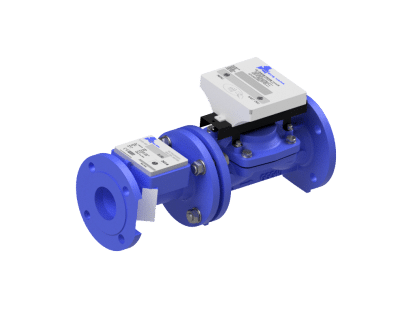
An Ultrasonic Water Meter is a type of water meter that does not contain any mechanical parts and measures the flow of water using sound signals. It is used for measuring the water passing through the ultrasonic water meter and displaying it on a screen. The ultrasonic water meter measures the water passing through it using sound signals. In this way, it has no mechanical parts.
Since it has no mechanical parts inside, it is longer-lasting. It is possible to develop smarter irrigation solutions by using water meters.
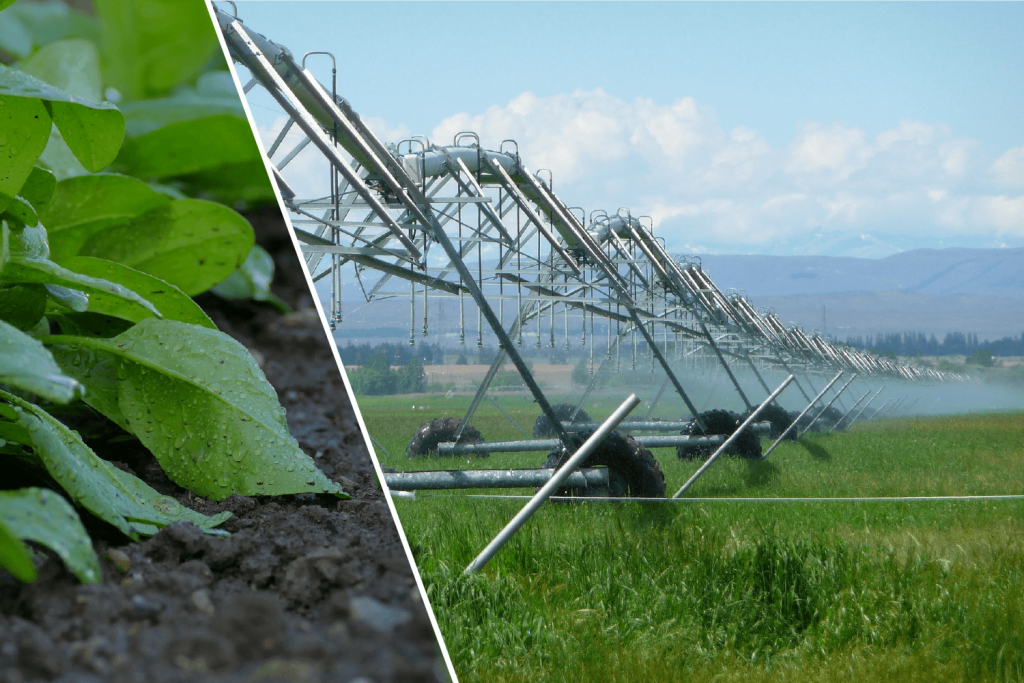
Ultrasonic water meters are especially preferred in agricultural irrigation systems. It has widespread use because it is both more resistant to contamination and can be easily applied in large diameters. The biggest factor in this is the measurement technique. Since it measures with ultrasonic sound waves, it does not contain any rotating mechanical parts. It is a completely straight pipe.
How Does an Ultrasonic Water Meter Work?
An ultrasonic water meter works by using dual transducers placed inside a straight pipe. There are holes placed at specific points inside this pipe. Transducers send ultrasonic waves into the water passing through the meter. The transit time of the water is calculated by measuring the return time of these sent waves from the meter. In this way, the amount of water is directly measured and shown to the user.
The internal structure of the ultrasonic water meter does not contain any mechanical parts; therefore, it does not require maintenance. In case of malfunctions that may occur in the transducers, they can be replaced under pressure using special equipment. This feature allows maintenance to be performed without the need to cut off the water in case of malfunctions.
What is a Water Meter?
A water meter is a measuring instrument connected to the entrance of the water installation that determines the amount of water used and displays it on a screen. It is widely used in homes, workplaces, and agricultural irrigation. The water meter measures the amount of water passing through it in terms of volume (m³).
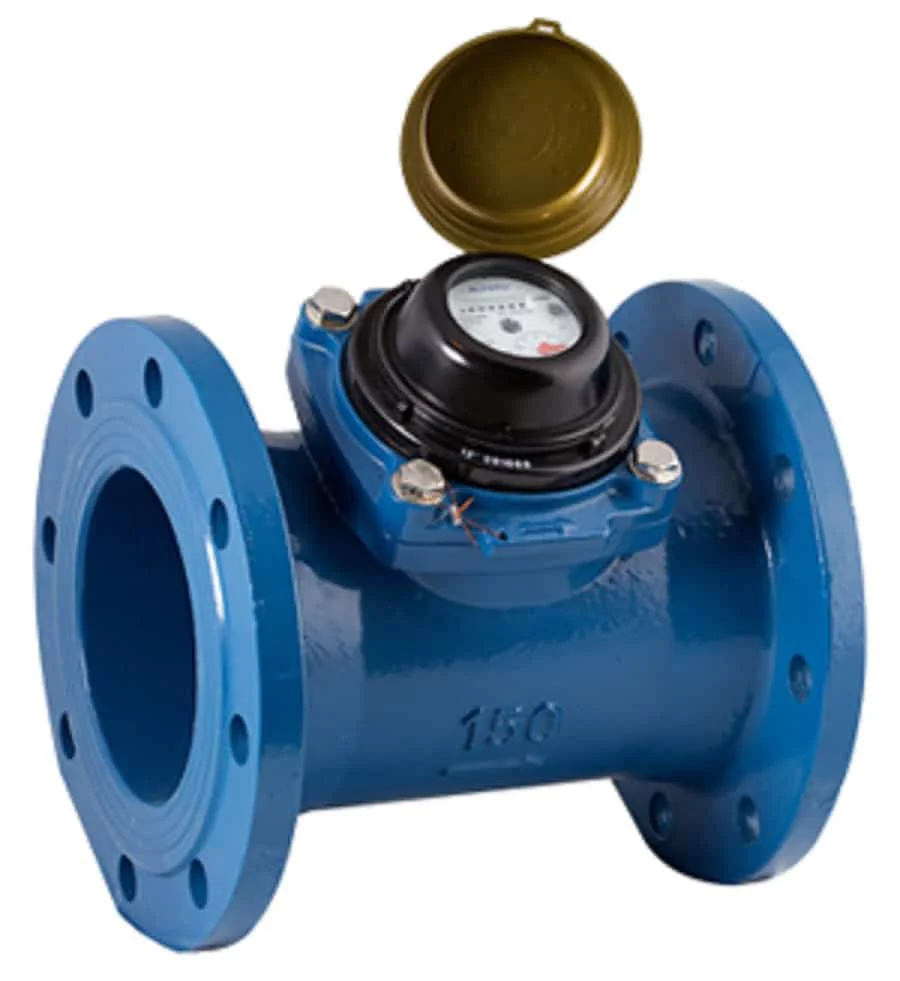
Different types and sizes of water meters are available. There are basically two types: mechanical water meters and ultrasonic water meters. These two types of water meters are based on the differences in their measurement techniques. While mechanical water meters generally use mechanical gear systems, ultrasonic water meters measure using sound waves.
What is a Mechanical Water Meter?
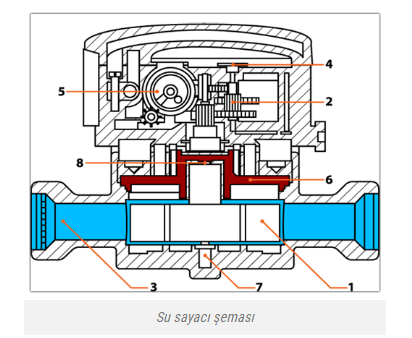
- Impeller
- Mechanism
- Water Flow
- Mechanical Reducer
- Display Device
- Waterproof Zone
7-8 Hard Ruby Axles
This meter, of which you see the diagram, is a dry system meter. Because in this system, the water flow (3) that rotates the impeller (1) does not come into contact with the mechanism (2). That is, the flowing water (3) rotates the impeller (1), and the impeller rotates the mechanism (2) with the help of various gears. The mechanism (2), again with the help of gears, moves the display device (5) via the mechanical reducer, and the indicator digits turn. The impeller and the mechanical parts of the meter are fixed with the help of hard ruby axles (7-8). And it is separated from the flowing water (3) by the waterproof zone (6), that is, the isolation part.
Wet meters have a very simple working principle because the parts there come into direct contact with water and the entire mechanism moves. But it is not suitable to operate wet meters with very dirty water because the impurities in the water can cause the meter to malfunction. For this reason, the vast majority of meters in our homes are dry system meters.
In addition to these, cold-hot water meters are also available. Naturally, the internal mechanisms of a meter operating with hot water are made of more robust and durable materials.
Advantages of Ultrasonic Water Meter
- No mechanical parts.
- No contamination and clogging problems.
- Very long-lasting.
- Pressure drop is almost non-existent.
- Easy to use.
- Automation compatibility with digital output.
- Maintains calibration for a long time.
Ultrasonic Irrigation Meters
Ultrasonic irrigation meters provide precise and reliable measurement of water consumption in agricultural irrigation operations. The working principle is to determine the speed and thus the flow of water by measuring the changes in the speed of ultrasonic sound waves passing through the water. This type of measurement is quite accurate and reliable, making it very suitable for various agricultural applications.
Ultrasonic irrigation meters do not contain mechanical parts, which makes them particularly durable and low-maintenance. Since these types of meters have no moving parts, wear and tear is much less. This means both longevity and reduces the risk of measurement precision decreasing over time.
Additionally, ultrasonic meters do not measure air and other particles. This feature solves a problem encountered in traditional mechanical meters because such meters can count air bubbles or other substances as water. This allows ultrasonic meters to provide more accurate readings.
These generally have low energy consumption and long battery life. This reduces the maintenance costs and overall operating costs of the device. Furthermore, the installation of these meters is generally easy and they can be made suitable for all kinds of installation situations.
Some ultrasonic irrigation meters can store consumption data and allow users to access this data later. This is a very valuable feature for the management and optimization of agricultural irrigation operations.
Consequently, ultrasonic irrigation meters offer high precision and reliability in measuring and monitoring water consumption in agricultural irrigation operations. They help in the efficient and sustainable use of water resources while also reducing irrigation costs.
Differences Between Ultrasonic and Mechanical Water Meters
First and foremost, ultrasonic type water meters must be used in agricultural irrigation. Since mechanical meters contain moving and flow-obstructing parts, they clog over time in unclean water and become unusable very quickly. Due to this contamination, sometimes the meters become completely unusable. Another situation is clogging in mechanical meters; these clogs, again caused by dirty water, can cause serious damage to irrigation lines.
In contrast, since ultrasonic meters measure the flow of water passing through them with sound waves, they do not contain any parts, making them like a completely straight pipe. They do not have problems such as clogging, malfunction, or becoming unusable. They maintain their calibration and measurement precision for a long time. Another advantage is that since they do not create a pressure drop, they can also be used easily in low-pressure systems. Additionally, they do not measure air either.
In general, ultrasonic water meters are quite advantageous for use in agricultural irrigation. The general advantages of ultrasonic water meters are;
- No mechanical parts.
- No contamination and clogging problems.
- Very long-lasting.
- Pressure drop is almost non-existent.
- Easy to use.
- Automation compatibility with digital output.
- Maintains calibration for a long time.
Especially in agricultural areas, if your water is dirty, you must prefer an ultrasonic water meter.
Advantages of Ultrasonic Meters
The advantages of using ultrasonic meters in agricultural irrigation are quite numerous and generally focus on measurement precision, durability, energy efficiency, and ease of use. Here are some important advantages:
Longer Lasting: Since ultrasonic meters have no moving parts, wear and tear are at a minimum. This provides a longer-term performance.
More Precise Measurement: Ultrasonic meters can make more precise measurements than mechanical meters with plastic impellers. They have a higher R value (measurement precision), which provides more accurate water usage data.
Does Not Count Air Passage: Ultrasonic meters do not count air passage, so they only measure water usage. This ensures more accurate measurement data.
Easy Installation: Installation of ultrasonic meters is easy and they are not affected by inclined installation. This makes them more user-friendly, unlike mechanical meters.
Low Pressure Loss: Ultrasonic meters create very low pressure loss, which reduces energy consumption caused by the pump.
No Risk of Clogging: Ultrasonic meters have no risk of clogging. This reduces the regular maintenance requirement and also prevents potential problems that could block water flow.
Not Affected by Temperature Fluctuations: Ultrasonic meters are not affected by changes in water temperature. This is especially important in climates where temperature changes are frequent.
Longer Battery Life: Ultrasonic meters generally have a battery life of over 10 years. This requires less maintenance and reduces usage cost.
Data Logging: Ultrasonic meters store the monthly consumption data of the past 12 months in their memory. This is a valuable feature for monitoring and managing water usage.
These advantages show that ultrasonic meters are a more efficient and reliable option than mechanical meters in agricultural irrigation applications.
Main Features of Ultrasonic Water Meter
MID Certificate: This product has a MID (Measuring Instruments Directive) certificate indicating measurement precision and reliability.
Stationary Mechanism: This meter uses a stationary mechanism that minimizes friction and wear.
Low Energy Consumption: It has low energy consumption providing a battery life of up to 10 years.
Low Initial Measurement Value: It has a very low initial measurement value.
Does Not Measure Air: It does not measure air, only water flow, allowing for more accurate data.
Low Pressure Loss: It creates very low pressure loss, thus ensuring energy efficiency.
Flexible Installation: It can be installed in a way suitable for any installation situation.
Particle Resistance: It is not affected by particles in the water, making it suitable for harsh environmental conditions.
LCD Screen: The LCD screen provides a user-friendly experience.
Historical Consumption Inquiry: Users can inquire about past water consumption data.
Durability: Since it contains no moving parts, it is much longer-lasting than mechanical meters.
Various Communication Protocols: It can communicate via M-Bus, RF, and Pulse protocols. This ensures compatibility with various systems.
These features make this ultrasonic water meter an ideal choice for applications requiring precise water measurement and long-term durability.
Pre-Paid Ultrasonic Agricultural Irrigation Meter
Pre-Paid Ultrasonic Agricultural Irrigation Meter has a series of advantages for the effective and efficient management of agricultural irrigation, as well as offering a significant savings potential. Also, these meters, which work with money paid in advance and credit loaded into a card, are also called prepaid agricultural irrigation meters. Here are the important aspects of this device:
-
Suitable for Agricultural Irrigation Needs: This device has the technical specifications necessary to meet agricultural irrigation needs. This increases effectiveness and efficiency in managing irrigation processes.
-
High Reliability Measurement System: Thanks to high-precision ultrasonic measurement technology, this device is not affected by sediment and other materials in the water. This increases the accuracy and reliability of measurements.
-
Free Management Software: This device comes with free management software that allows users to effectively manage irrigation data. This helps to manage irrigation processes more effectively and reduce costs.
-
Savings Potential: This device provides savings of up to 40% in total water consumption costs. This both helps protect natural resources and significantly reduces costs for users.
All of these features show that the Pre-Paid Ultrasonic Agricultural Irrigation Meter offers an efficient and effective solution in agricultural irrigation applications. This device can help both farmers and agricultural enterprises better manage their irrigation processes and reduce the cost of these processes.
Importance of Water Meter Use in Agricultural Irrigation
The use of water meters in agricultural irrigation is extremely important for several reasons. Water is one of the most critical resources for agricultural practices worldwide, and the management and conservation of this resource are essential for both increasing productivity and ensuring a sustainable agricultural practice.
Efficiency: Water meters precisely measure and monitor water consumption. This allows farmers to determine which areas require more or less irrigation and thus optimize irrigation schedules. It also reduces unnecessary water consumption and waste.
Cost Savings: Water consumption data is necessary to manage and control irrigation costs. By accurately and precisely measuring water use, water meters offer farmers the opportunity to reduce water costs and increase operational efficiency.
Sustainability: Water is a limited and valuable resource, and its effective management is critical for a sustainable agricultural practice. Water meters help track water use and protect water resources.
Water Quality Management: Some advanced water meters can also measure water quality parameters. This can help monitor the quality of water used in agricultural practices and thus prevent potential negative effects on plant health and yield.
Legal Compliance: In some regions, monitoring and reporting water consumption is a legal requirement. In these cases, water meters are important for meeting legal requirements.
In conclusion, water meters are an important tool for measuring, monitoring, and managing water consumption in agricultural irrigation practices. They provide a range of benefits such as efficiency, cost savings, sustainability, water quality management, and legal compliance.
Importance of Water Meter in Automatic and Remote Irrigation
As is known, today, as in the past, the monitoring of irrigation systems is widely done by eye. However, with changing working conditions and techniques, it is now desired that these irrigations be done automatically or requested to be carried out with remote control. Especially with the entry of drip irrigation systems and subsurface drip irrigation systems into our lives, irrigation systems have become more suitable for remote control and automatic controls. In this field, GSM remote irrigation systems, timers (irrigation timers), and different types of automation systems are used.
Along with all these automatic control systems, there is a need for prevention systems regarding the quality and duration of the irrigation performed and in case of any negativity. Water meters step in at exactly this point, undertaking an important task for measuring the irrigation performed and detecting problems experienced in the system. With a water meter you add to the automatic irrigation system, you can be sure that your land is being irrigated and can detect any leakage in the system early or provide immediate intervention with automatic adjustments.
Especially in remote-controlled irrigation systems, the use of water meters will provide you with convenience and ensure that your irrigation system is working correctly.
In general, the advantages of using ultrasonic water meters in automatic irrigation:
- It provides efficient and predictable irrigation by measuring the amount of irrigation.
- It helps you irrigate the land as much as it needs.
- In remote monitoring systems, you are sure that irrigation is being done.
- It provides feedback by warning you in cases such as malfunctions, leaks, or seepages.
- It adds functionality to your automatic irrigation system.
Water Meter in Esular Smart Irrigation System
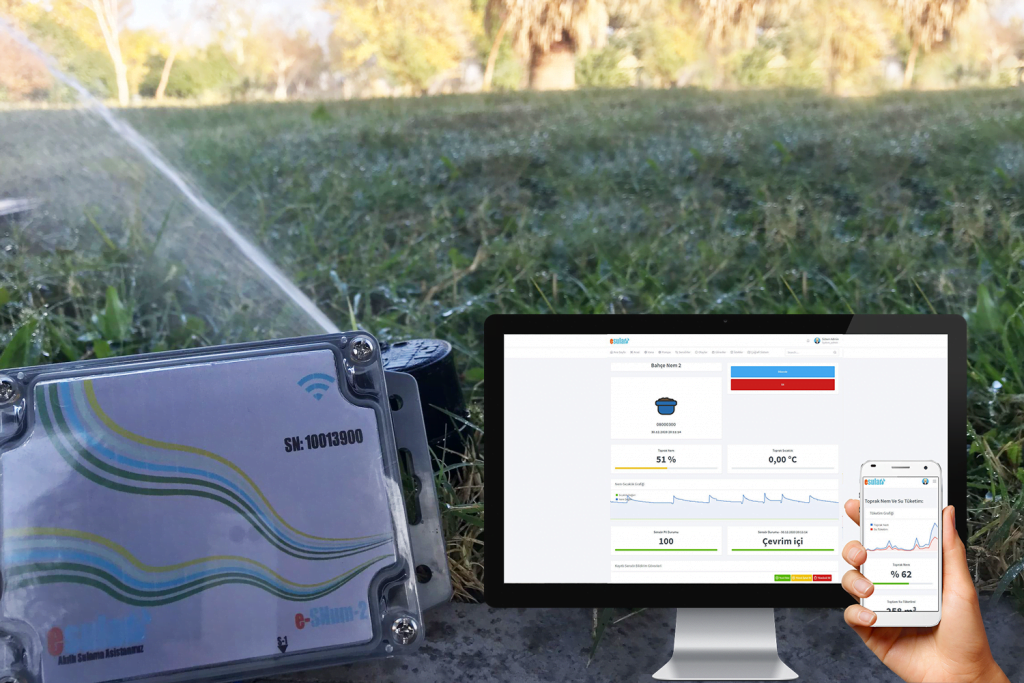
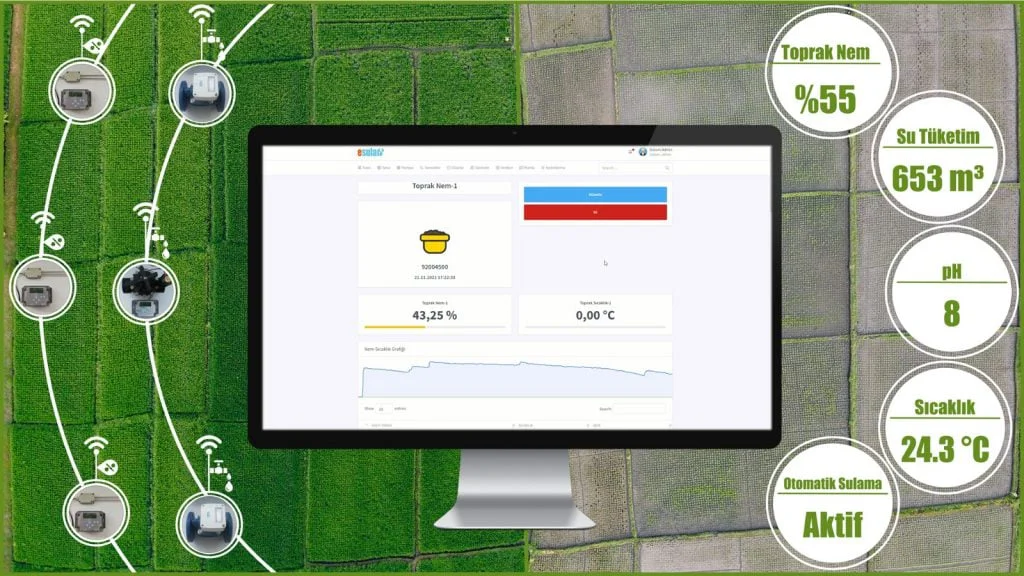
Esular's smart irrigation system consists of a range of hardware and software solutions, and water meters play an important role among these solutions.
Measurement and Control: Ultrasonic water meters are one of the most important elements of the irrigation system. Because they precisely measure the amount of water used during irrigation. This makes it possible to control and optimize water use, thus preventing water waste.
Data Collection: Water meters provide continuous and real-time water consumption data. This data is analyzed by Esular's cloud-based software, and more efficient irrigation strategies are determined. Water consumption data is also valuable for monitoring long-term consumption trends.
Leakage and Leak Detection: Ultrasonic water meters help identify potential leaks or seepages at an early stage by detecting abnormal water use. This helps protect valuable water resources and keep costs under control.
Automation: Water meters form the basis of the automatic control of Esular's smart irrigation system. These meters have the capability to automatically stop the irrigation system when a certain amount of water is consumed. This feature prevents over-irrigation and increases agricultural productivity.
In short, water meters are a critical part of Esular's smart irrigation systems. Their capabilities to measure, control, analyze, and automate water consumption provide water savings to farmers and other users, improve water management, and increase agricultural productivity.
Yorumlar