
Tüm Yazılar

How to Grow Oranges?
Orange cultivation is a branch of agriculture that holds great importance from both historical and economic perspectives. This fruit, belonging to the citrus family, is widely consumed worldwide and is an important source of vitamins and antioxidants for health. Orange cultivation is carried out in different regions depending on climate conditions, and high yields can be achieved with good care. Factors such as soil quality, irrigation methods, fertilization techniques, and disease management are of great importance in the growing process. Additionally, the characteristics of different orange varieties and harvest timing are also matters that growers should pay attention to. Orange cultivation plays an important role in local and international trade, besides contributing to the agricultural economy. Supported by modern agricultural techniques and sustainable methods, orange cultivation is constantly being developed to increase product quality and minimize environmental impacts. Therefore, orange cultivation is an agricultural sector that will maintain its importance in the future with both traditional agricultural practices and innovative solutions.
Where Do Oranges Grow?
Globally, oranges are grown in many countries, primarily in tropical and subtropical climates. Especially countries like Brazil, China, India, the USA, Spain, and Mexico are leading countries in orange production. Brazil provides a large portion of the world's orange production, and the state of Sao Paulo is at the center of orange cultivation. In Turkey, orange production is concentrated especially in the Mediterranean, Aegean, and Southeastern Anatolia regions. The warm and temperate climates of these regions provide suitable conditions for orange cultivation. Among Turkey's prominent cities in orange production are Antalya, Mersin, Izmir, and Adana. These cities are regions with a large share in orange production and play an important role in our country's orange exports.
What are the Orange Varieties?
Orange is a citrus fruit rich in diversity. There are many different orange varieties worldwide. Here are some popular orange varieties:
Valencia Orange: Sweet and juicy, usually used in juice production. It matures in February and can be harvested until April.
Navel Orange: Its skin is thin and can be easily peeled. Its interior is juicy and delicious. It is preferred because it is harvested late, usually in January and February.
Cara Cara Orange: Its internal color is red and it has a different flavor profile than normal oranges. It matures in December and can be harvested until March.
Hamlin Orange: It is an early-maturing variety and ideal for juice production. It is widely grown in regions like Florida and Brazil.
Washington Orange: It has separate segments, can be easily peeled, and has no bitterness. It is one of the most famous orange varieties in the world, usually preferred for fresh consumption.
Blood Orange: It is a variety with a red internal color. It is grown in Spain and Italy, especially preferred for orange juice.
Each of these varieties shows suitability for different climate and growing conditions and is preferred according to consumption purposes. Each has its own unique flavor profile and area of use.
Climate and Soil Structure in Orange Cultivation
Orange trees prefer tropical and subtropical climates. High temperatures and sufficient rainfall, along with daily temperature fluctuations, are very important for the healthy growth and fruit yield of orange trees. Suitable soil structure is also a critical factor for orange cultivation. Well-drained, slightly acidic, and humus-rich soils allow the roots of orange trees to develop healthily and absorb nutrients effectively. Soils rich in organic matter contribute to the healthy growth of trees and increase fruit quality. Turkey is home to several important regions with ideal conditions for orange cultivation. Especially the Mediterranean, Aegean, and Southeastern Anatolia regions are prominent regions in terms of orange production. Cities like Antalya, Mersin, Izmir, and Adana are in a leading position in our country's orange cultivation. The hot summers, mild winters, and fertile soils of these regions offer ideal environments for high-quality and delicious orange cultivation.
Planting Orange Saplings
An orange sapling is an important plant that needs to be planted at the right time for healthy growth and abundant fruit production. Usually, the most suitable time for planting is the autumn months of September and October. Saplings planted during this period are nourished by rainwater throughout the winter, strengthening their root systems and starting to grow more healthily in the spring. The orange sapling prefers temperate climates and is a plant that must be protected from the cold. If it is to be grown in cold regions, it is recommended to grow it in protected areas in pots. During planting, it is necessary to bury the root ball of the sapling well and cover its surroundings firmly with soil. Regular irrigation and care after planting ensure that the sapling's roots become firm and strong. Correct application of these steps is important for creating a long-term healthy orange orchard, because saplings that start healthy will eventually turn into mature trees that produce efficient and high-quality fruit.
Does the Orange Tree Need Much Water?
Orange trees require regular irrigation, especially during active growth periods (in spring and summer months). Depending on the soil structure, although they are in well-drained soils, it is important to water them frequently in case of drought during the summer months. Because their roots go deep, the irrigation water must be at a sufficient depth to reach the root system. However, excessive irrigation should be avoided because this situation can lead to root rot. Irrigation frequency may vary depending on the soil type, climate conditions, and season. Especially in sandy or light soils, more frequent irrigation may be required, while in clayey soils, irrigation can be done less frequently. Regularly checking the soil moisture level and adjusting the irrigation timing accordingly supports the healthy development of saplings.
Fertilization in Orange Cultivation
Fertilization is of critical importance for healthy growth and efficient fruit harvesting. Orange trees especially need basic nutrients such as nitrogen, phosphorus, and potassium. Therefore, the fertilization process supports the development of the plant by providing these nutrients to the soil. It is important to perform a soil analysis before starting the fertilization process. These analyses determine the nutrient levels in the soil, allowing us to identify which fertilizer should be used and in what amount. Phosphorus and potassium fertilizers are usually applied according to the tree's canopy drip line. Holes are opened at a depth of 15-20 cm in these areas and the fertilizers are placed. Nitrogen fertilizers, on the other hand, should generally be applied 2-3 times in the spring period according to the needs of the trees. This helps to encourage new shoots and flowering. When the fertilization process is done at the right time and in the right amounts, orange trees grow healthily, produce efficient fruit, and become more resistant to diseases.
How Many Years Does an Orange Tree Start Bearing Fruit?
Orange saplings usually start to form fruit within 2-3 years after being planted. However, for fully productive production, the tree needs to mature between 8 to 10 years. Orange trees usually experience their most productive periods between 10 and 40 years of age. During this process, trees provide optimum yield with healthy growth and good care, fruit quality increases, and they show continuous product productivity.
Orange Harvest
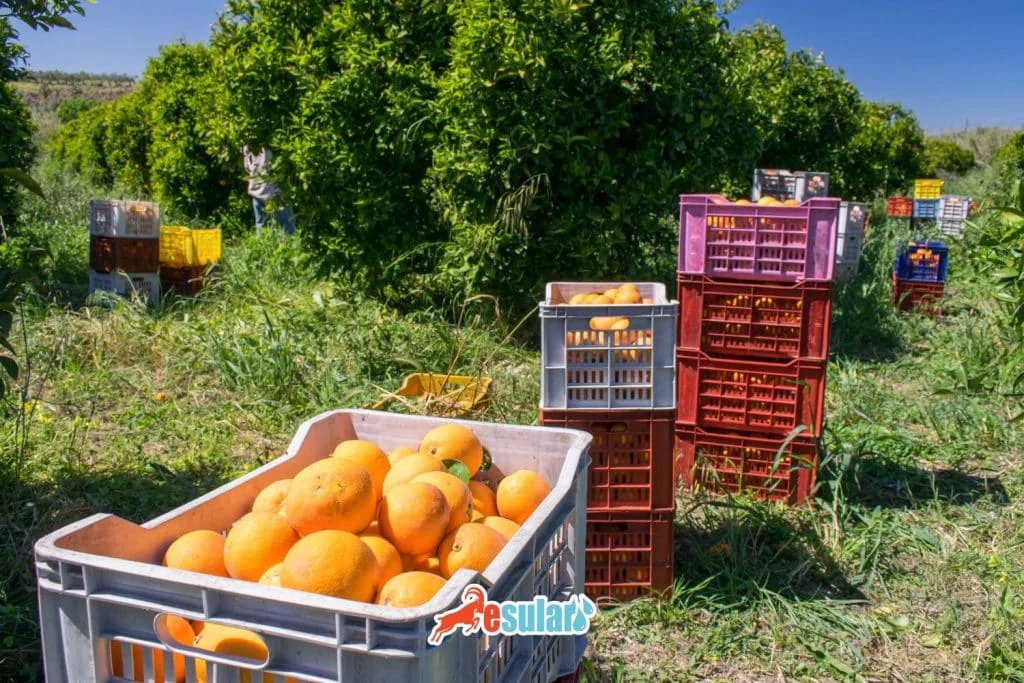
Harvest time can vary greatly depending on the orange variety and the region where it is grown. For example, Navel oranges are usually harvested between October and June, while Valencia oranges are harvested between March and October. When determining the orange harvest, the ripening process along with the skin color and texture of the fruits are taken into account. A few ripe oranges falling from the tree usually indicate that the harvest time has come. Especially in oranges grown for juice production, not only the external appearance but also specific characteristics such as acidity level and essence are important. For this reason, producers test the fruits using portable devices to measure these characteristics. Harvesting is usually done by hand; fruits are collected by twisting from the stem or cutting using scissors. For thin-skinned fruits, the use of scissors is more common. Orange harvest is an important process not only for being released to the market for fresh consumption but also for juice production, and correct timing is a critical factor determining product quality.
How Many Kg Does 1 Decare of Orange Yield?
Orange yield can vary depending on many factors. However, in general, the amount of oranges obtained per decare may vary depending on the variety of orange grown, climate conditions, soil quality, and irrigation and fertilization methods. Typically, between 2 and 3 tons of oranges can be obtained per decare from a well-tended orange orchard.

Yorumlar