
Tüm Yazılar

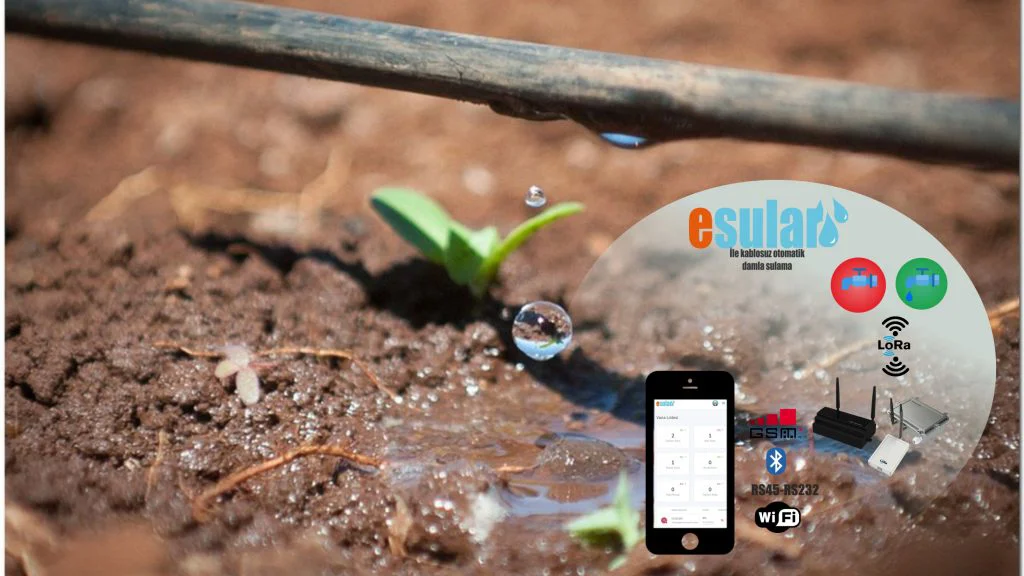
Drip Irrigation System
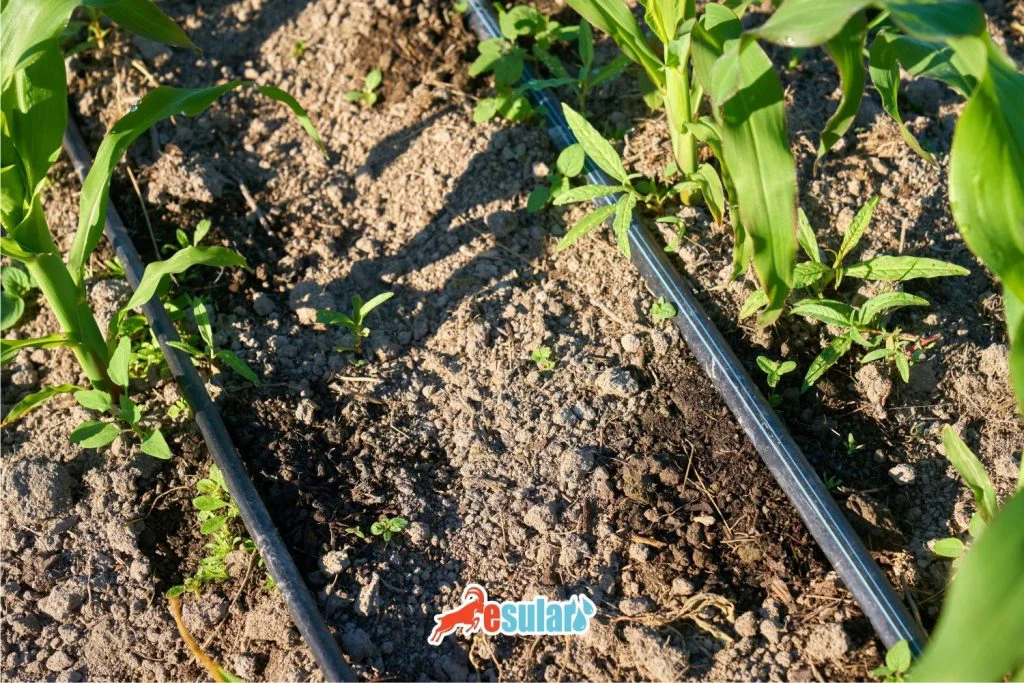
Drip Irrigation System is considered the irrigation method with the highest water application efficiency today. When we compare the water application efficiencies of different irrigation methods, it is seen that the drip irrigation method is the most efficient.
Water Application Efficiencies:
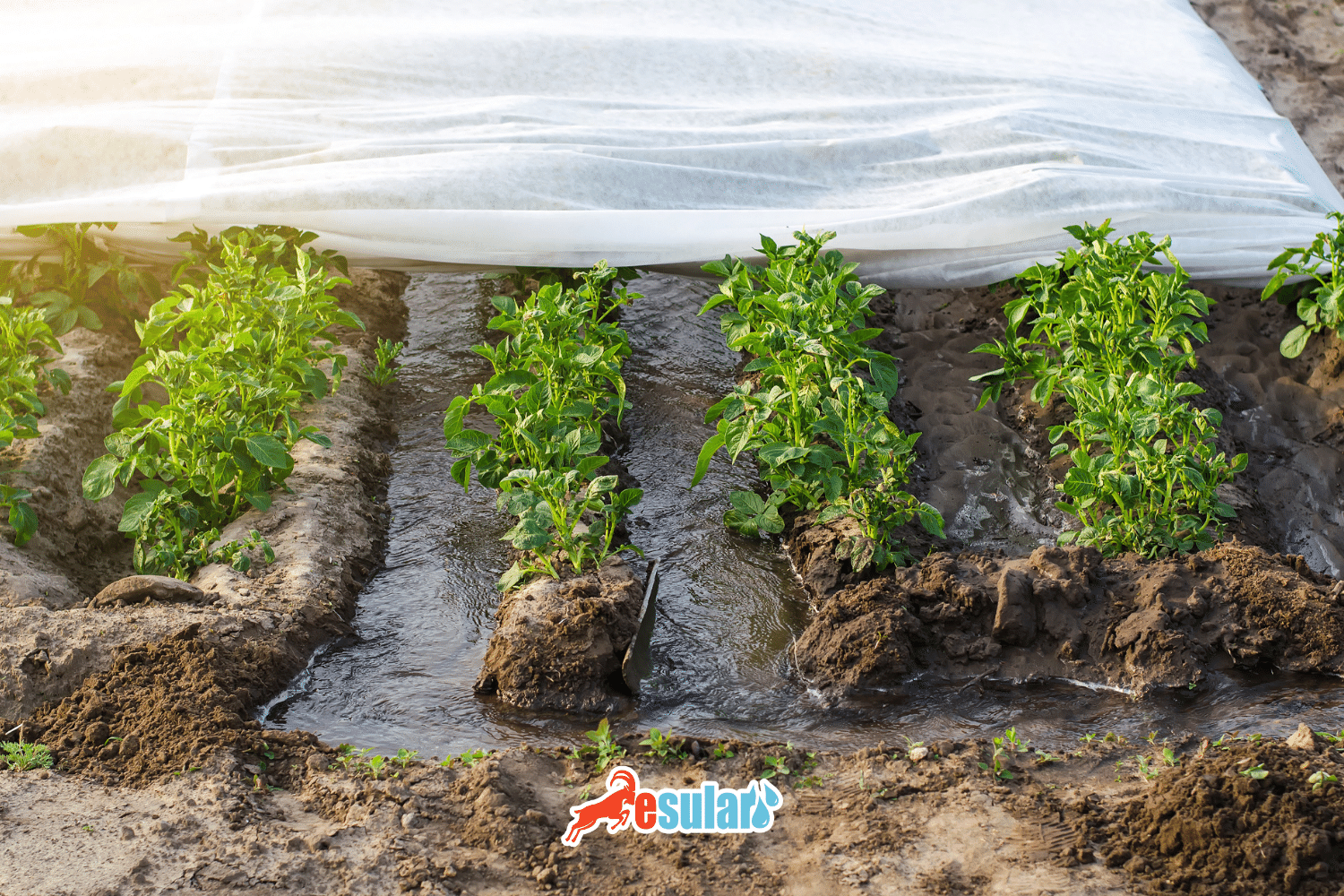
- Flood Irrigation 50%
- Furrow Irrigation 70%
- Sprinkler Irrigation 80%
- Drip Irrigation 90%- 95%
In other words, if a plant needs 100 units of water in one irrigation, it may be necessary to give 200 units of water to the field with the flood irrigation method for the plant to receive this water. However, with the drip irrigation method, the amount of water that needs to be given to the field will be only 110 units. Drip irrigation makes it possible to achieve high efficiency by providing water savings.
What is Drip Irrigation?
Drip irrigation of agricultural areas and landscape areas is one of the activities that most affect the cost factor in this field today. Depending on the size of the area to be irrigated and the nature of the plants in the area that need water, many different irrigation methods can be used. Drip irrigation is the irrigation method where the least water is consumed while the highest efficiency is achieved. This irrigation method, which was developed for agricultural purposes, is now used effectively in almost every field. Since manual irrigation is laborious and costly in very large areas forested in our cities, the drip irrigation method is used. In agricultural areas, it is almost an agricultural standard. It is widely used together with spray irrigation systems.
It is very easy to use automatic irrigation solutions in drip irrigation systems. It is possible for you to perform more efficient irrigation with remote, wireless irrigation systems. As esular, we make your drip irrigation systems remotely controllable. With our wireless battery-powered valve control system, we enable you to perform automatic irrigation in your drip irrigation areas without additional energy.
Drip Irrigation System Diagram
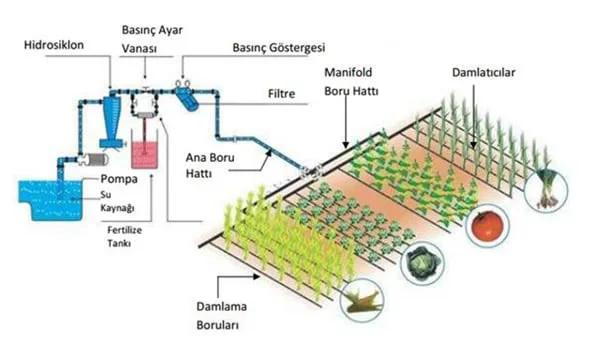
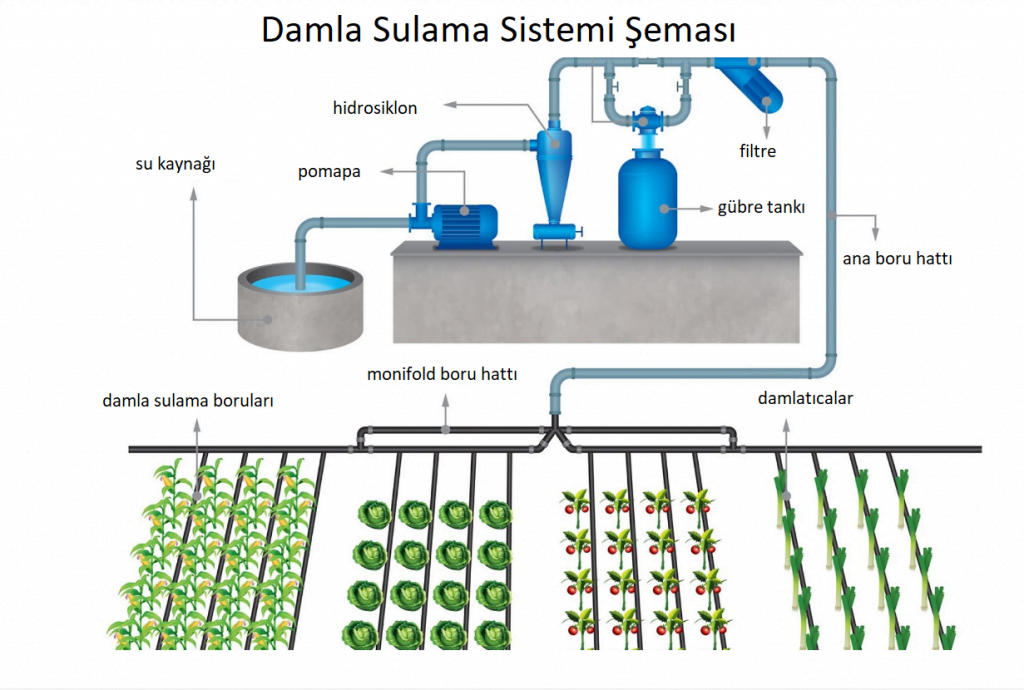
When creating a drip irrigation system diagram, attention should first be paid to the preparation phase of the project. Some important information needs to be known during the project preparation phase; these are: determining the location, position, and slope status of the land where the system will be installed, determining the location and type of water source, determining the physical structure of the soil, determining the plant species, inter-row and intra-row spacing. Other important elements to consider are project design and the installation phase.
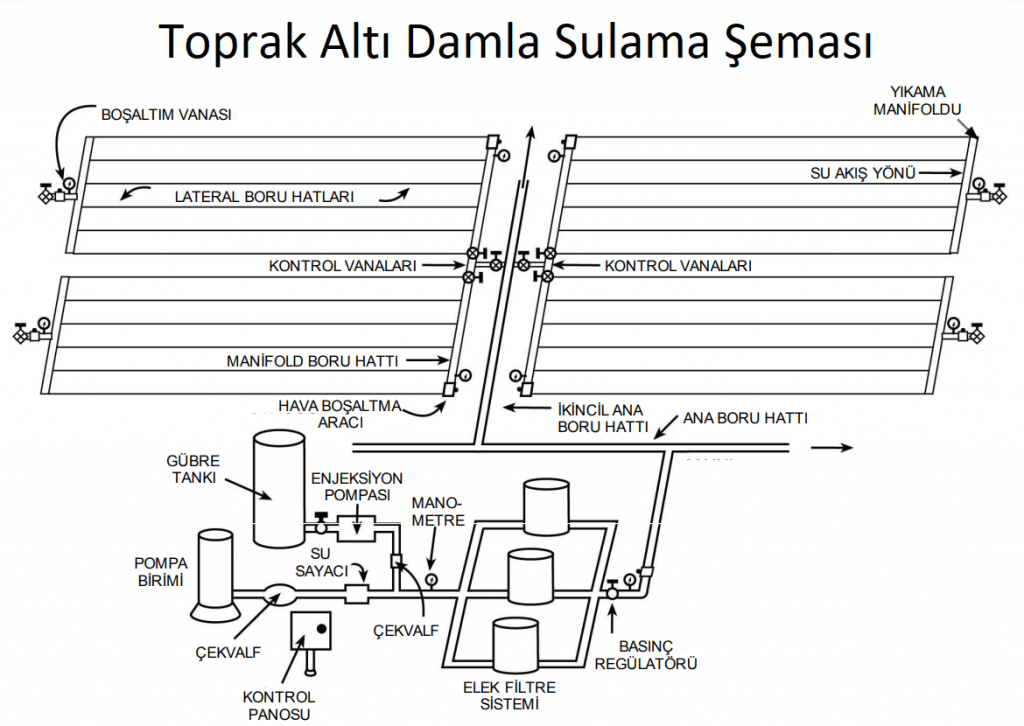
Subsurface Drip Irrigation System Diagram
When creating a subsurface drip irrigation system diagram, it is important to pay attention to the preparation phase of the project. There is some important information that needs to be known at this stage. First, the location, position, and slope status of the land where the system will be installed must be determined. In addition, determining the water source location and type, understanding the physical structure of the soil, determining the plant species to be grown, and the inter-row and intra-row distances should be considered at this stage.
While creating the project, attention should also be paid to the design and installation phases of the system. In the design phase, components such as the layout of the drip irrigation line, pipe diameters, filter systems, water pressure regulators, and valves should be determined. In the installation phase, the physical setup of the system is carried out.
Correct evaluation of all these elements is important to ensure that the subsurface drip irrigation system works efficiently and effectively.
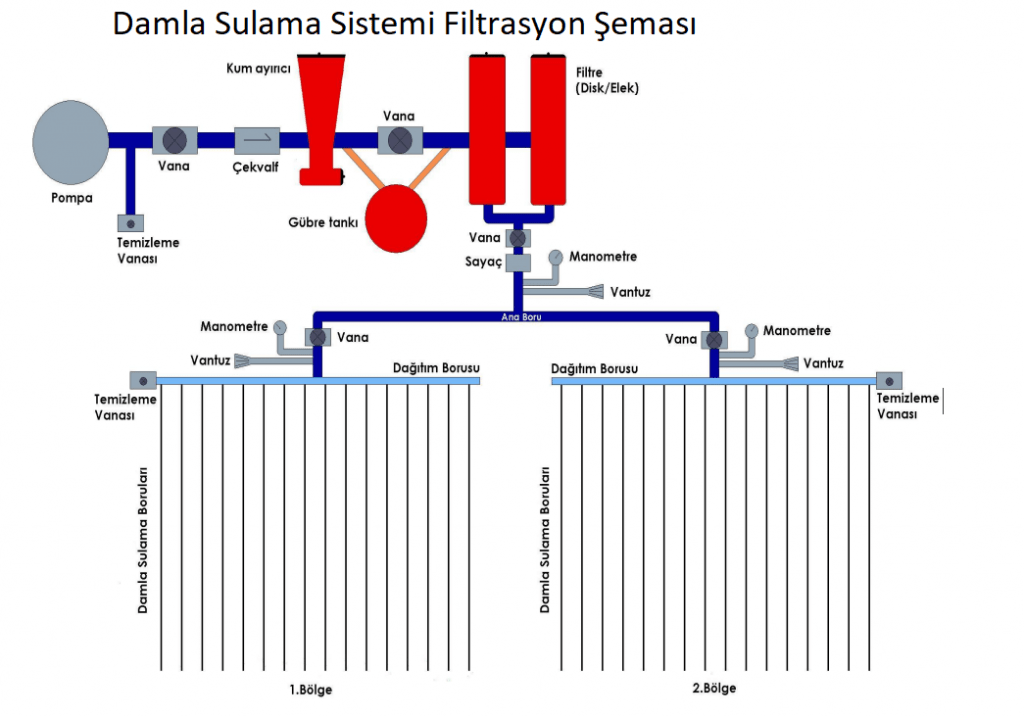
Drip Irrigation System Filtration Diagram
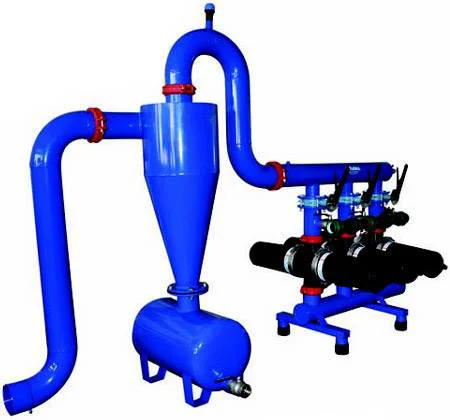
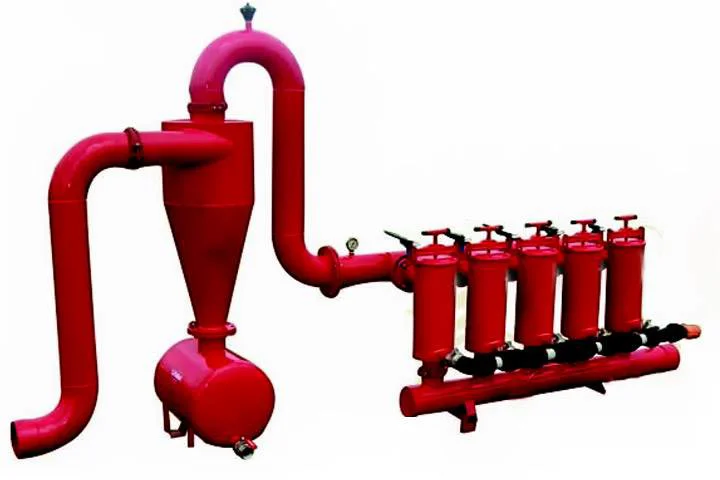
Drip irrigation system filtration diagram is designed to ensure the cleaning of particles and pollutants in the irrigation water. This diagram includes the filtering process for the proper operation of the system and the protection of drip irrigation lines.
Elements of a Drip Irrigation System
- Water source
- Pump unit
- Control unit
- Sand separator (hydrocyclone)
- Sand filter (gravel filter)
- Fertilizer tank
- Filter (disc/screen)
- Main pipeline
- Sub-main pipeline
- Distribution pipeline (manifold)
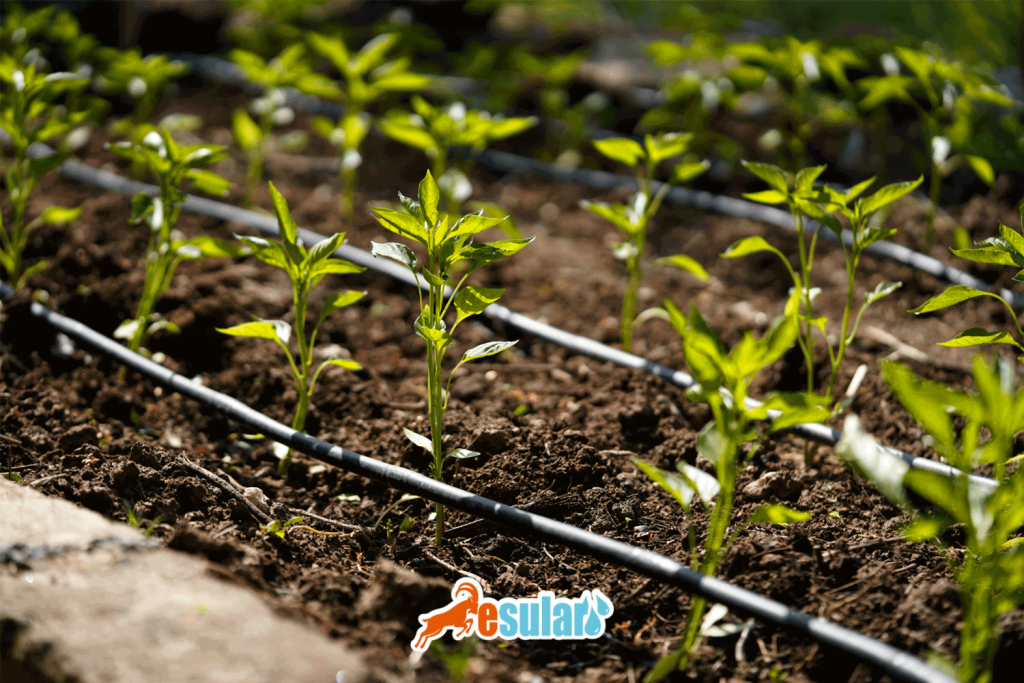
- Drip pipes (lateral)
- Drippers
Types of Drip Irrigation Pipes
In the drip irrigation method, drip irrigation pipes used as laterals can be classified as follows according to production method and dripper function.
- Drip irrigation pipes
- According to production method
- According to dripper function
- Pipes with drippers integrated into the pipe (in-line)
- Standard dripper pipes
- Round dripper pipes
- Pressure-compensated (PC) dripper pipes
- Flat dripper pipes
- Adjustable flow rate dripper pipes
- Pipes with drippers attached onto the pipe (on-line)
According to Production Method
In pipes with drippers integrated into the pipe, drippers are placed inside the pipe at certain intervals during production and the pipes are offered for use. These drippers can be in the form of round or flat drippers.
According to Dripper Function
Standard drippers are produced to provide a constant flow rate at 1.0 atm operating pressure. For example, drippers with a flow rate such as 2.0 L/hour or 3.8 L/hour at 1.0 atm operating pressure. In these drippers, the flow rate increases when the operating pressure increases.
Pressure-compensated drippers, on the other hand, provide a constant flow rate at variable pressures. In this type of drippers, a constant flow rate (for example, 2.0 L/hour or 1.6 L/hour etc.) is obtained at application pressures varying from 1.0 atm to 3.5 atm along the lateral.
Drip Irrigation Filter Selection
Clogging of sprinklers and drippers used in irrigation systems is one of the biggest problems that arise. The process of removing foreign substances that cause clogging from water in irrigation systems is called filtration. Filtration is the best protection method to prevent sediments from entering equipment such as drippers, sprinklers, valves, etc. used in the irrigation system. Because finding a clogged dripper, cleaning or replacing it is a very expensive and laborious task. Therefore, filtration constitutes the most important control unit of an irrigation system. To obtain filtered water of the desired quality, the most suitable filter equipment must be selected according to the water source and place of use. While Making Filter Selection;
- Maximum and minimum water pressure
- Water source type (underground-surface)
- Future needs and modifications
- Required water flow (capacity)
- Required water quality
- Required filtration (pore size or micron)
- Pre-filtration requirement
Parameters such as these should be taken into account.
Drip Irrigation System Filter Selection Table
Pollution Type and Water Source | Filter Type to be Used |
Well Sand | Hydrocyclone Automatic Disc Filter Automatic Screen Filter |
River, Reservoir Algae, Moss Organic Matter | Hydrocyclone Gravel Filter Automatic Screen Filter Automatic Disc Filter |
Lake, River, Canal Suspended Solid Matter Silt | Gravel Filter Automatic Disc Filter |
Well, Lake, River Silt | Hydrocyclone Gravel Filter Automatic Disc Filter |
Treated Wastewater | Gravel Filter Automatic Screen Filter |
Pre-filtration | Suction Filter |
Advantages of drip irrigation systems
- Drip irrigation systems are methods where water is consumed at the lowest level. Here, the most important advantage stands out as economy.
- Drip irrigation systems increase efficiency because they ensure equal distribution of fertilizer and water.
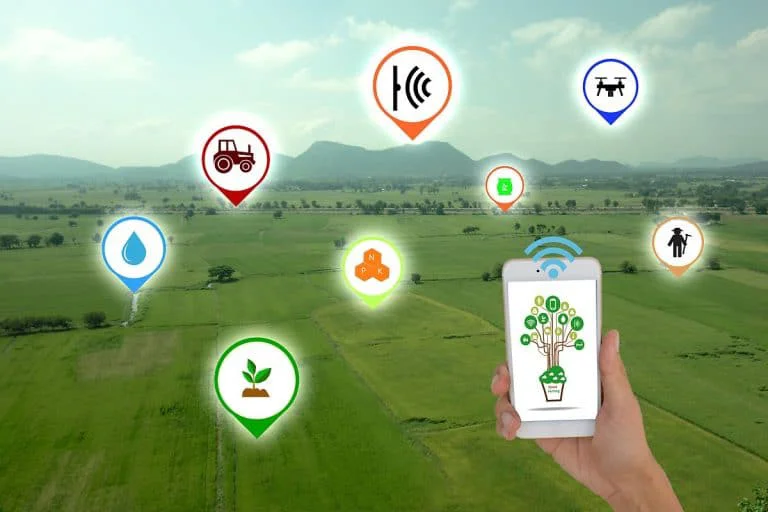
- Drip irrigation systems can be used with the automation method and can operate with a near-zero human factor.
- Drip irrigation systems are extremely advantageous when the initial installation cost and long-term benefits are considered. The system is quite long-lasting and has very low maintenance costs.
- By ensuring that plants reach the optimum amount, soil fertility is protected while sufficient irrigation is provided.
- These systems are minimally affected by weather conditions; for example, they do not have the disadvantages of spray systems in windy weather.
- Drip irrigation systems require less pressure than other systems, so electrical energy consumption is also lower.
- It improves the soil because it optimizes the ground temperature.
- Plant development will be supported as the humidity rate in the air will decrease.
- Drip irrigation systems can be easily used on rugged terrain.
- Soil hardening is prevented, and hoeing frequency is reduced. By the nature of the system, the aeration rate of the soil is quite high.
In conclusion, drip irrigation systems, besides being the most widely used agricultural irrigation method today, are an irrigation method used effectively in landscape areas and in every other field where needed. For effective irrigation in very large areas, the most effective solution is to install drip irrigation systems. On lines hundreds of meters long, drippers integrated onto the pipes ensure proper moistening of the soil and irrigation of the plant. Automatic drip irrigation systems can preferably be used in every field. Again, in large lands, drip irrigation can be done this way using the lowest level of human labor. Automatic drip irrigation can be done using time timers, as well as much more advanced systems. New generation tools with artificial intelligence digital units can detect the irrigation need and perform irrigation at appropriate intervals. Of course, time timers are the method currently used in automatic drip irrigation systems. More advanced methods have not yet become widespread.
Why Drip Irrigation Systems Should Be Used
Drip irrigation systems are an effective irrigation method that saves water by preventing over-irrigation of plants. This system prevents the waste of water resources by providing water in amounts suitable for the plant's needs. Just as over-irrigation has negative effects on plant growth, it can also cause unnecessary depletion of water resources. Drip irrigation ensures that water is used correctly and in a controlled manner, thus contributing to the efficient use of water. At the same time, it positively affects plant health by protecting the mineral richness of the soil. When used in appropriate environments, the drip irrigation system contributes to sustainable agricultural practices by increasing efficiency while reducing irrigation costs.
The widespread use of drip irrigation systems emerged in the 1950s in Israel with the start of an approach focusing on water conservation and efficiency. This system created a revolution in irrigation technologies, creating a major impact especially in Israel. Drip irrigation units and similar sprinkler systems are also widely used among farmers in India. These technologies allow them to obtain rich harvests by significantly exceeding the efficiency of irrigation methods of the past century. Although most farmers in India still use traditional methods, drip irrigation units and similar systems are offered in affordable models on online sales platforms, especially to meet the needs of small landowners. In Italy, farmers have increased field efficiency by 35-40% by using drip irrigation pipes. These new drip irrigation systems have provided significant benefits to Italian farmers by significantly reducing water consumption, especially during dry periods.
How to Use a Drip Irrigation System?
A drip irrigation system is defined as a central irrigation system where a tank and a booster pump are located. In this system, water or liquid fertilizer is delivered to special drip pipes with a certain pressure. In drip irrigation systems, specially designed drip pipes are used and correct pressure adjustment is important. The design of drip irrigation systems, which requires landscape architecture expertise, should be done carefully. Basic principles of the project such as pipe quality, creation of the line diagram, and procurement of main tools must be determined correctly. Random planning can make it difficult to obtain an effective yield from the drip irrigation method. Drip irrigation systems can be operated automatically or manually.
The Best Irrigation Solution For Your Field: Professional Drip Irrigation Systems From Us!
Installation of Drip Irrigation Systems
The installation of drip irrigation systems is based on the principle of giving small amounts of water to the plant root zone at regular intervals by determining the moisture deficiency in the soil. This method is used in various production areas such as field crops and orchards. Drip irrigation systems can be divided into two main classes: surface and subsurface. To benefit from drip irrigation systems in the best way, it is important to pay attention to certain criteria and to make applications according to these criteria.
Reach the highest efficiency at the lowest cost!
Drip irrigation systems can increase agricultural efficiency by providing an average increase of around 70% in product quantity depending on conditions. It makes it possible for the crop to ripen at least 20% earlier in agricultural irrigation. Besides this, it includes advantages such as reducing hoeing costs, reducing the need for agricultural spraying, and reducing the amount of fertilizer to be used to the minimum level. The drip irrigation method stands out in providing long-term benefits. It minimizes erosion by protecting the qualities of the soil. In free-release surface irrigation methods, erosion is an inevitable result. Drip irrigation systems make it possible to obtain continuous yields in the long term by minimizing soil loss.
Yorumlar