
Tüm Yazılar

Importance of Irrigation in Alfalfa Farming
Methods to increase yield with soil moisture sensor in alfalfa cultivation play a critical role in determining the correct irrigation time and ensuring water savings. Alfalfa is one of the forage crops with high nutritional value in animal husbandry. However, correct irrigation strategies are essential for efficient alfalfa production. Too much water leads to root rot, while too little water leads to yield loss. At this point soil moisture sensors come into play, determining the irrigation time with scientific data.
What is a Soil Moisture Sensor and How Does It Work?
Soil moisture sensors are devices used to measure the amount of water in the soil and determine the plant's water needs. Thanks to these sensors, the amount of water in the soil can be measured precisely, ensuring the most efficient irrigation for the plant. You can find detailed information in our content 👉
Soil moisture sensors are used to proportionally measure the amount of water in the soil. Due to its structure, soil retains a certain amount of water, and the amount of this water can be measured by various electrical and mechanical methods up to the saturation point. You can find detailed information in our content 👉
Benefits of Soil Moisture Sensor in Alfalfa Cultivation
- Correct Irrigation Time → The plant is irrigated without experiencing water stress.
- Water Savings → Unnecessary irrigation is avoided.
- Yield Increase → The plant grows under optimum moisture conditions.
- Reduced Disease Risk → Root diseases caused by over-irrigation are prevented.
- Energy and Labor Savings → The number and duration of irrigations are optimized.
How to Implement Smart Irrigation with Soil Moisture Sensor?
It is possible to increase yield in alfalfa cultivation with soil moisture sensors. The soil moisture sensors used measure the moisture level in the field gradually to determine the correct irrigation time. The system defines threshold values such as minimum moisture, irrigation point, maximum moisture and wilting point . In this way, when the soil's moisture content falls below the determined irrigation point, the sensor can automatically start irrigation. Thus, the optimum moisture level is maintained without the plant experiencing water stress and without unnecessary water consumption.
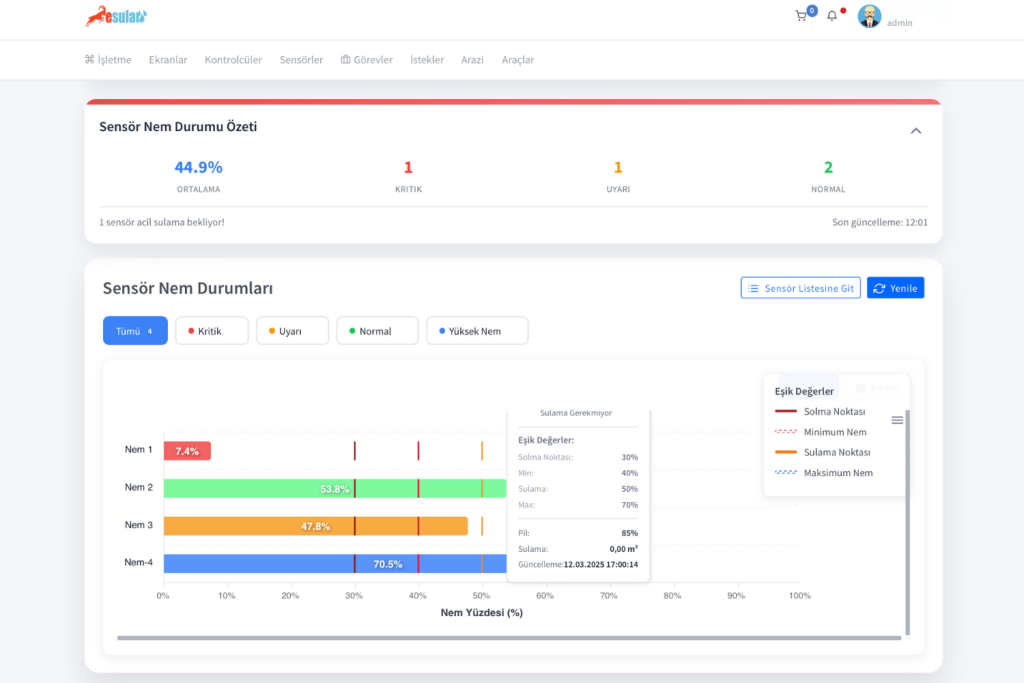
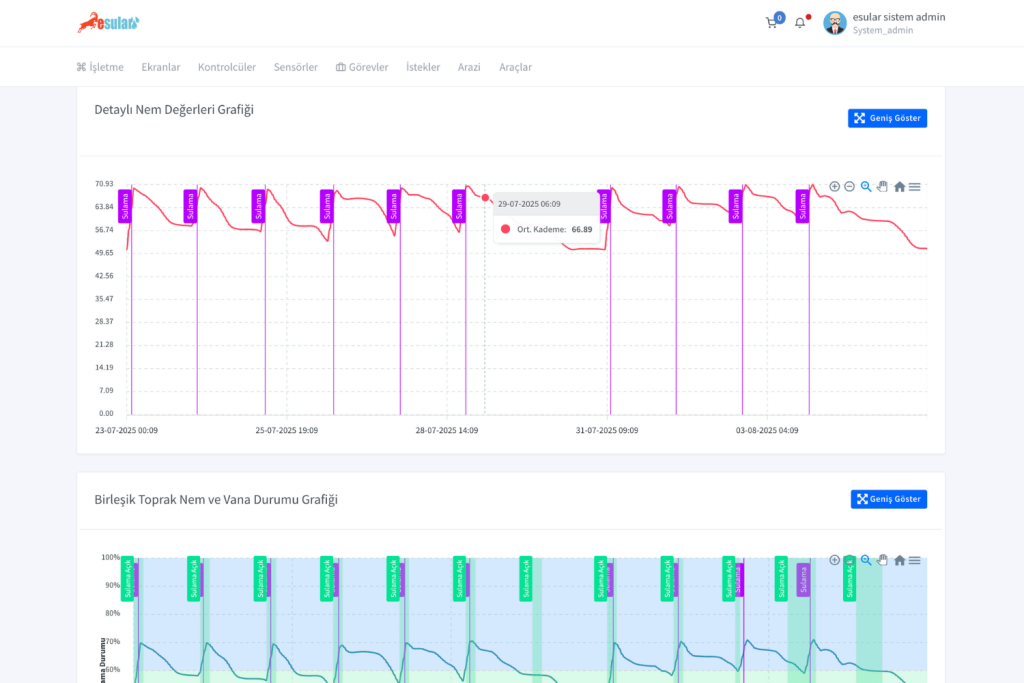
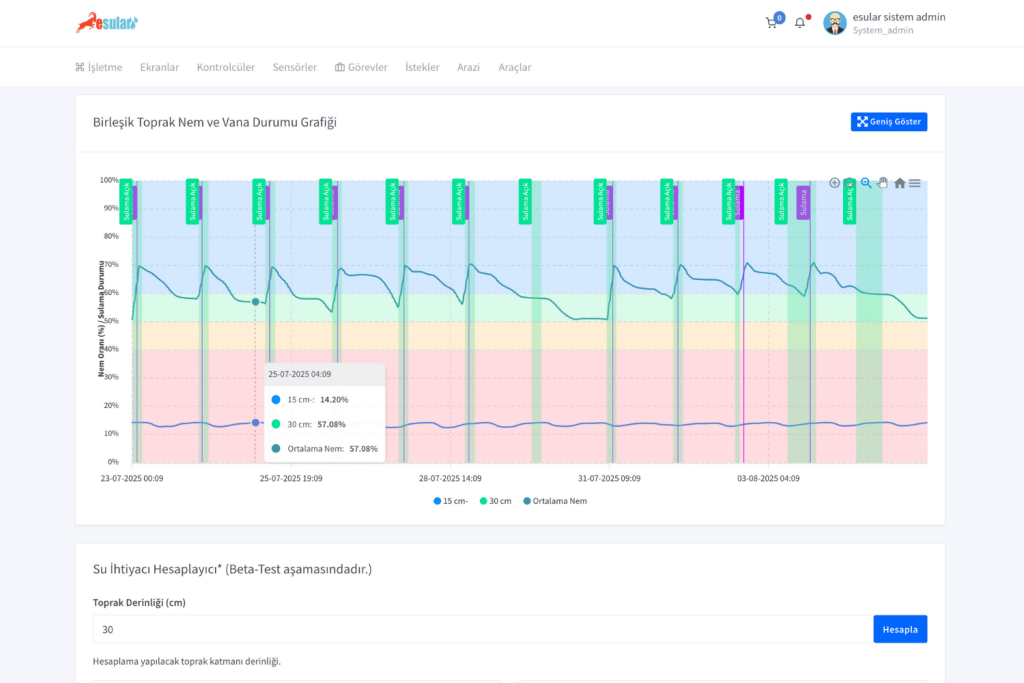
In the homepage of our esular application below, the Sensor Moisture Status section provides a summary of the moisture values, wilting point, min, max, and irrigation points for each moisture sensor. By clicking 'Go to sensor list', you can view more detailed graphs for each sensor.
Alfalfa, known as the queen of forage crops, stands out as a high-nutritional-value and productive crop. However, one of the most important keys to this high yield is correct and timely irrigation. Alfalfa is one of the plants that needs the most water throughout its growth period. Overcoming the challenges of traditional irrigation methods and utilizing resources in the most efficient way is now possible with modern agricultural technologies. Data from soil moisture sensors form the brain of smart irrigation systems. These systems analyze real-time moisture data collected from the soil and can automatically open and close irrigation valves at the precise time. Farmers can create special irrigation scenarios according to the needs of the alfalfa and the determined threshold values. For example, when the moisture content in the critical root depth of the soil falls below the determined level, the system automatically starts irrigation, preventing the plant from experiencing water stress.
Smart Irrigation Steps for Alfalfa
To maximize yield in your alfalfa field, the steps to follow when setting up a smart irrigation system are:
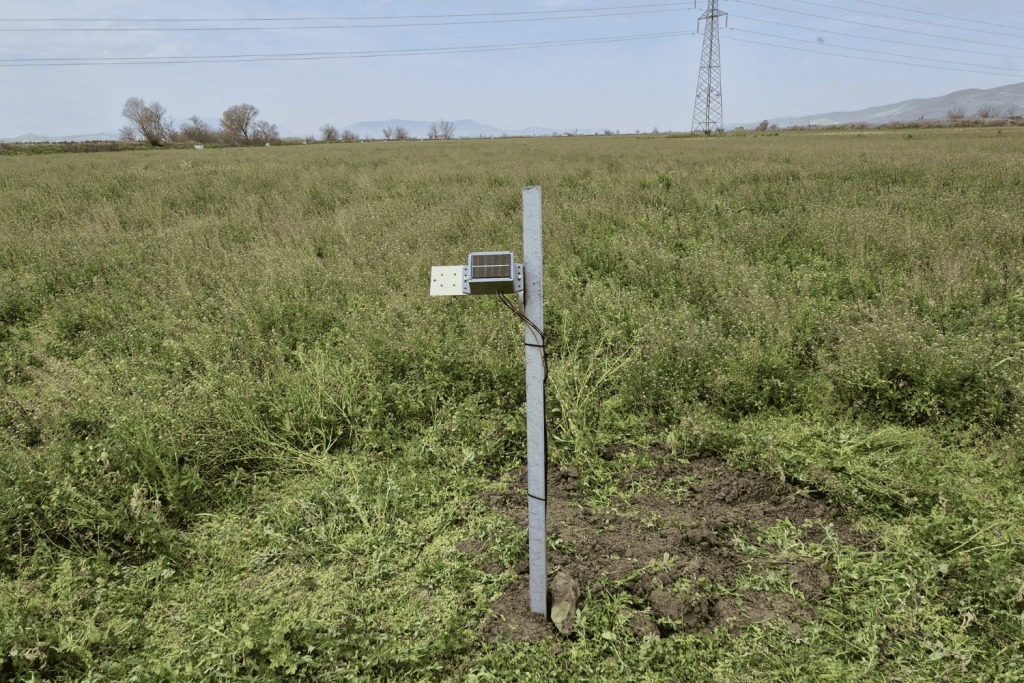
- Strategic Sensor Placement: Sensors should be placed at strategic points, considering different soil types and slopes, to represent the general soil structure of your field. Measuring moisture at the effective root depth of alfalfa, between 1.2 to 1.8 meters, will increase the accuracy of irrigation decisions.
- Setting Threshold Values: The water requirement of alfalfa varies according to harvest periods. Generally, it is recommended to irrigate twice: 7-10 days before each harvest and one week after harvest. In a smart irrigation system, these periods are defined as critical threshold values. Considering the soil structure and the alfalfa's growth stage (e.g., new establishment or mature plant), the moisture levels at which irrigation will start and stop are set. This forms the basis of smart irrigation automation. At this point, by using soil analysis data, you can easily calculate information such as your soil's water holding capacity and wilting point through our esular application's "soil water holding capacity calculator" tool. Based on these calculated values, you can determine the minimum, maximum, and irrigation intervals for the soil moisture sensors. If you have the esular full system , you can manage your irrigation processes fully automatically and intelligently according to the soil moisture sensor values.
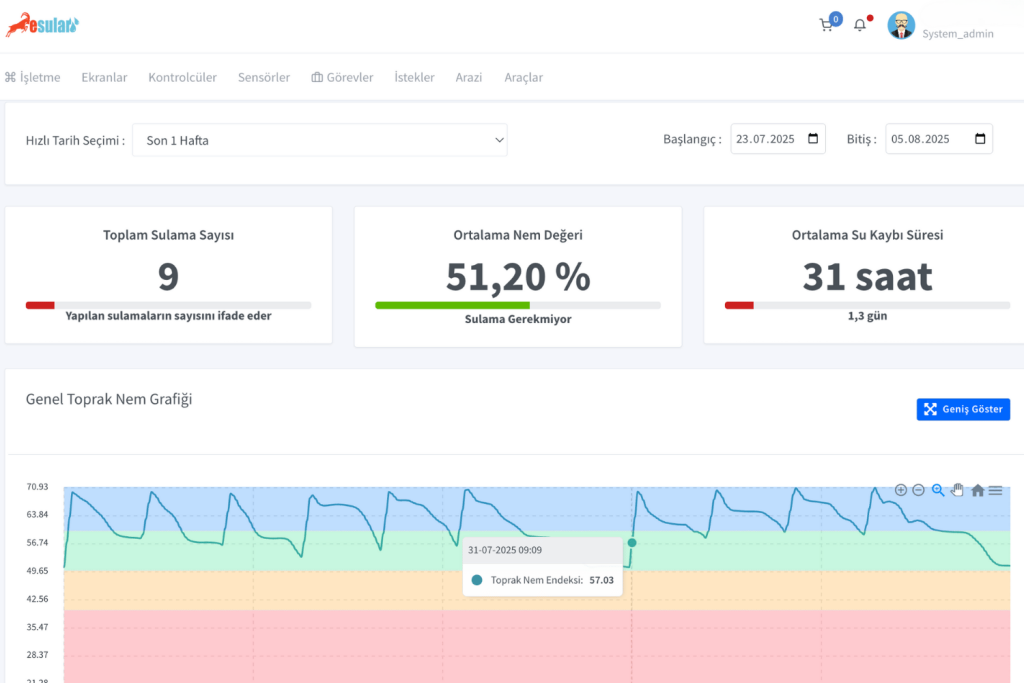
- Real-time Data Monitoring and Analysis: Soil moisture levels are monitored instantly via mobile application or web interface. Graphical data makes it easier to predict water movement in the soil, how alfalfa uses water, and when the next irrigation is needed.
- Automation and Remote Control: Irrigation programs can be set to operate fully automatically based on data collected from sensors. This eliminates labor costs and can save up to 50% on water and energy. Additionally, there is an option to manually/automatically intervene in the irrigation system at any time and place.
Conclusion: Technology is Essential for Sustainable and Profitable Alfalfa Farming
In conclusion, to achieve high yield and quality targets in alfalfa farming, it is inevitable to abandon traditional irrigation habits and benefit from the opportunities offered by technology. Soil moisture sensors and smart irrigation systems integrated with them offer an efficient production model by delivering water and fertilizer directly to the plant's root zone. This technology enables acting with environmental responsibility awareness and maximizes the economic potential of your field.

Daha Fazla İçerik İster misiniz?
Akıllı tarım hakkında en güncel içerikleri takip edin.
Çerez Kullanımı
Size daha iyi bir deneyim sunmak için çerezler kullanıyoruz. Gizlilik Politikası
Çerez Tercihleri
Hangi çerezlerin kullanılacağını aşağıdan yönetebilirsiniz. Zorunlu çerezler site işlevselliği için gereklidir ve kapatılamaz.
Zorunlu Çerezler
Gerekli
Site'nin temel işlevleri için gereklidir. Oturum yönetimi ve güvenlik.
Analitik Çerezler
Site kullanımını analiz etmemize yardımcı olur. Google Analytics vb.
Pazarlama Çerezler
Kişiselleştirilmiş reklamlar göstermek için kullanılır.
Yorumlar